Precipitation Precipitation Evaluation (MSWEP) CMIP6
CMIP6 Multi-Model Mean Context
Comparison with CMIP6 ensemble mean from 11 members.
Contributing models: ACCESS-ESM1-5, AWI-CM-1-1-MR, CNRM-CM6-1, CNRM-ESM2-1, EC-Earth3, FGOALS-g3, GISS-E2-1-G, INM-CM5-0, IPSL-CM6A-LR, MPI-ESM1-2-LR, MRI-ESM2-0
Synthesis
Related diagnostics
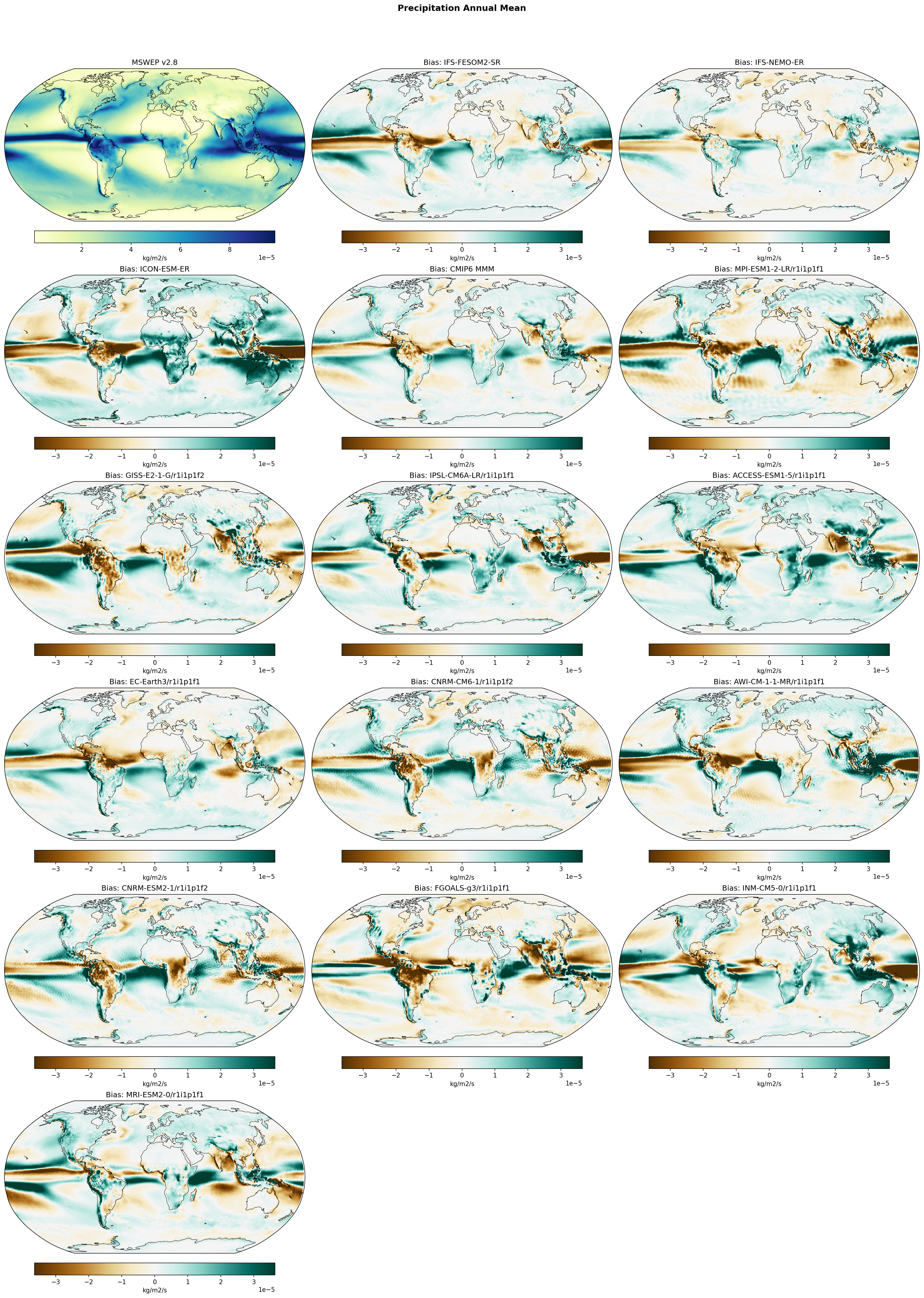
Precipitation Annual Mean Bias
| Variables | pr |
|---|---|
| Models | IFS-FESOM2-SR, IFS-NEMO-ER, ICON-ESM-ER, CMIP6 MMM, MPI-ESM1-2-LR/r1i1p1f1, GISS-E2-1-G/r1i1p1f2, IPSL-CM6A-LR/r1i1p1f1, ACCESS-ESM1-5/r1i1p1f1, EC-Earth3/r1i1p1f1, CNRM-CM6-1/r1i1p1f2, AWI-CM-1-1-MR/r1i1p1f1, CNRM-ESM2-1/r1i1p1f2, FGOALS-g3/r1i1p1f1, INM-CM5-0/r1i1p1f1, MRI-ESM2-0/r1i1p1f1 |
| Reference Dataset | MSWEP |
| Units | kg/m2/s |
| Period | 1980–2014 |
| IFS-FESOM2-SR | Global Mean Bias: 0.00 · Rmse: 0.00 · Pattern Correlation: 0.91 · Std Ratio: 1.01 · Tropical Mean Bias: 0.00 · Extratropical Mean Bias: 0.00 |
| IFS-NEMO-ER | Global Mean Bias: 0.00 · Rmse: 0.00 · Pattern Correlation: 0.96 · Std Ratio: 1.10 · Tropical Mean Bias: 0.00 · Extratropical Mean Bias: 0.00 |
| ICON-ESM-ER | Global Mean Bias: 0.00 · Rmse: 0.00 · Pattern Correlation: 0.77 · Std Ratio: 1.15 · Tropical Mean Bias: 0.00 · Extratropical Mean Bias: 0.00 |
| CMIP6 MMM | Global Mean Bias: 0.00 · Rmse: 0.00 |
Summary high
High-resolution IFS-NEMO-ER demonstrates remarkable skill, significantly outperforming IFS-FESOM2-SR, ICON-ESM-ER, and the CMIP6 multi-model mean by effectively minimizing the pervasive double-ITCZ bias. While IFS-FESOM2-SR retains typical coupled model errors (Amazon drying, Pacific double ITCZ), ICON-ESM-ER exhibits a strong systematic global wet bias.
Key Findings
- IFS-NEMO-ER achieves the highest pattern correlation (0.96) and lowest RMSE (0.79e-5 kg/m²/s), largely resolving the double-ITCZ bias that plagues most CMIP6 models.
- IFS-FESOM2-SR exhibits classic structural biases: a prominent southern ITCZ band in the Pacific, severe drying over the Amazon, and wet biases in the western Indian Ocean, resembling the CMIP6 Mean state.
- ICON-ESM-ER is an outlier with a large global wet bias (4.1e-6 kg/m²/s, ~4x that of IFS models) and overly intense/broad precipitation bands in the tropics.
- The Amazon 'dry bias', a common feature in CMIP6 (e.g., MPI-ESM, ACCESS, EC-Earth), is present in IFS-FESOM2-SR but absent in IFS-NEMO-ER, which instead shows a slight wet bias over the Andes.
Spatial Patterns
The most distinct feature is the 'Double ITCZ'—a spurious band of precipitation south of the equator in the Pacific. It is strong in IFS-FESOM2-SR, ICON-ESM-ER, and CMIP6 MMM, but faint in IFS-NEMO-ER. ICON shows excessive precipitation across the entire tropical belt (Atlantic and Pacific) and Indian Ocean. IFS-FESOM2-SR displays a dipole in the Indian Ocean (wet West, dry East/Maritime Continent).
Model Agreement
IFS-NEMO-ER shows the best agreement with MSWEP observations. IFS-FESOM2-SR aligns closely with the CMIP6 ensemble behavior (pattern correlation ~0.91). ICON-ESM-ER diverges significantly due to its systematic wet offset (pattern correlation ~0.77).
Physical Interpretation
The stark difference between IFS-NEMO-ER and IFS-FESOM2-SR (assuming similar atmospheric physics but different ocean components/grids) suggests that the eddy-rich ocean resolution (NEMO-ER) or specific air-sea coupling setup is crucial for maintaining correct tropical SST gradients, thereby suppressing the spurious southern convection branch (Double ITCZ). The systematic wetness in ICON suggests untuned convective microphysics or parameterization at this resolution.
Caveats
- Differences in specific resolution configurations (SR vs ER) between the IFS variants may confound the comparison of ocean model impact (FESOM vs NEMO).
- MSWEP observations have higher uncertainty over open oceans compared to land.
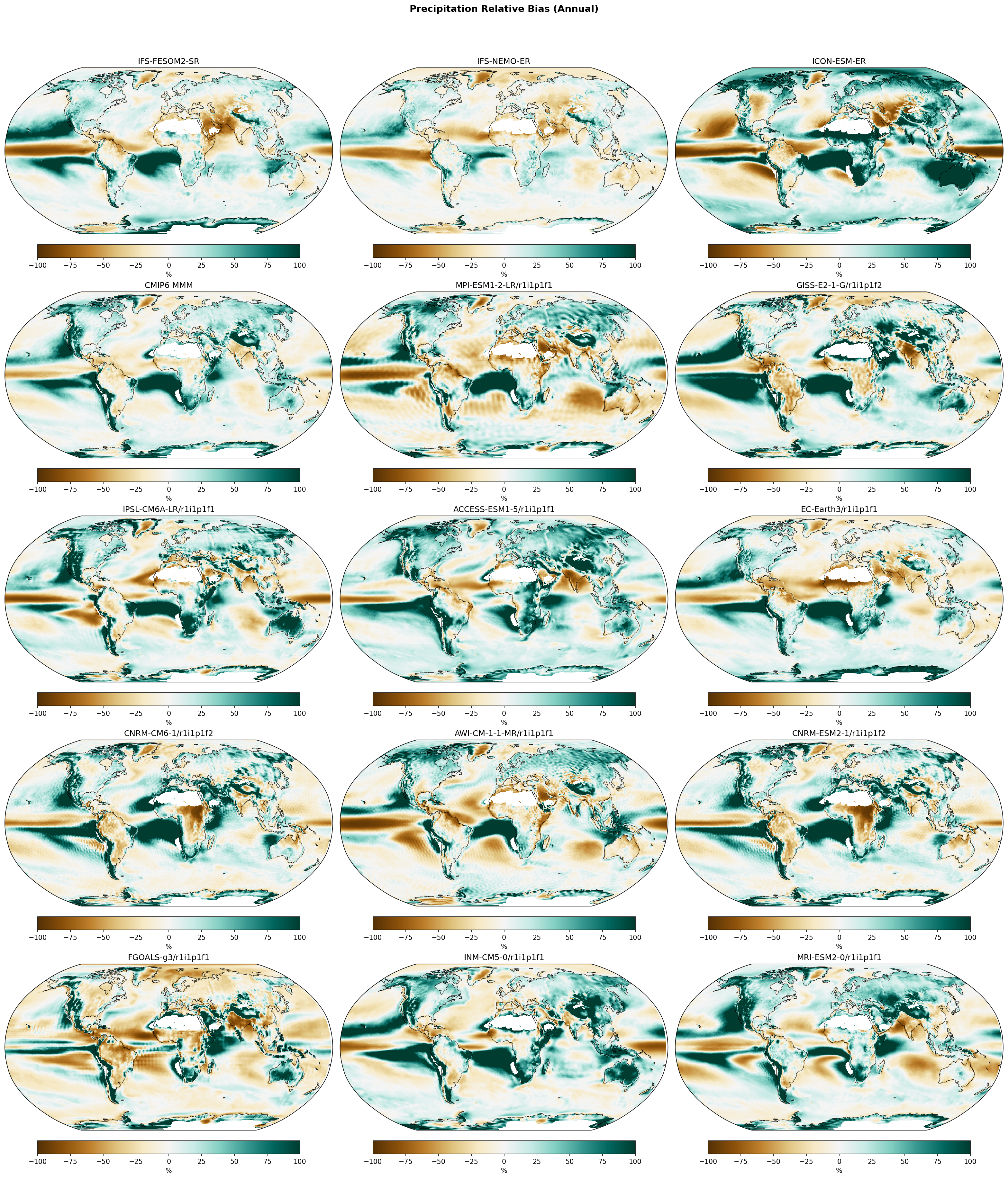
Precipitation Relative Bias (Annual)
| Variables | pr |
|---|---|
| Models | IFS-FESOM2-SR, IFS-NEMO-ER, ICON-ESM-ER, CMIP6 MMM, MPI-ESM1-2-LR/r1i1p1f1, GISS-E2-1-G/r1i1p1f2, IPSL-CM6A-LR/r1i1p1f1, ACCESS-ESM1-5/r1i1p1f1, EC-Earth3/r1i1p1f1, CNRM-CM6-1/r1i1p1f2, AWI-CM-1-1-MR/r1i1p1f1, CNRM-ESM2-1/r1i1p1f2, FGOALS-g3/r1i1p1f1, INM-CM5-0/r1i1p1f1, MRI-ESM2-0/r1i1p1f1 |
| Reference Dataset | MSWEP |
| Units | kg/m2/s |
| Period | 1980–2014 |
Summary high
This multi-panel map compares the annual mean precipitation relative bias (%) of three high-resolution EERIE models (IFS-FESOM2-SR, IFS-NEMO-ER, ICON-ESM-ER) against MSWEP observations and the CMIP6 ensemble. The analysis reveals that increased resolution in the EERIE models does not automatically resolve persistent systematic biases found in the broader CMIP6 generation.
Key Findings
- All three EERIE models and the CMIP6 Multi-Model Mean (MMM) exhibit a severe dry bias over the Amazon basin, reaching magnitudes of -50% to -100%.
- IFS-FESOM2-SR and IFS-NEMO-ER display the classic 'double ITCZ' bias, characterized by a spurious band of excessive precipitation (wet bias) in the Southeast Pacific Ocean.
- ICON-ESM-ER stands out with widespread, intense positive precipitation biases (wetting) across almost the entire tropical and subtropical ocean belt, distinct from the more zonally confined biases in the IFS models.
- A systematic wet bias over the Southern Ocean and Maritime Continent is visible across both EERIE and most CMIP6 models.
Spatial Patterns
The dominant spatial features are the zonal bands of bias in the tropics. The IFS models show a wet bias in the southern branch of the ITCZ (Pacific and Atlantic) and over the Indian Ocean. Over land, the Amazon drying is the most prominent negative feature. ICON-ESM-ER shows a more pervasive oceanic wet bias that covers the tropical Pacific, Atlantic, and Indian oceans, contrasting with sharp dry biases over tropical land masses (Amazon, Central Africa).
Model Agreement
There is strong agreement between IFS-FESOM2-SR and IFS-NEMO-ER, reflecting their shared atmospheric physics (OpenIFS); the change in ocean model (FESOM2 vs NEMO) has a limited impact on the large-scale precipitation bias structure. These IFS runs also resemble the CMIP6 model EC-Earth3 (also IFS-based). ICON-ESM-ER diverges significantly, showing a much more vigorous hydrological cycle over oceans compared to the IFS/CMIP6 consensus.
Physical Interpretation
The persistent Amazon dry bias suggests systematic deficiencies in land-atmosphere coupling, moisture recycling, or the positioning of the Walker circulation. The double ITCZ bias is typically linked to errors in meridional SST gradients and convective parameterizations failing to suppress precipitation off the equator. ICON's widespread oceanic wet bias indicates a likely over-active convective scheme or global energy budget tuning that favors excessive evaporation and precipitation over oceans.
Caveats
- Relative bias (%) highlights errors in lower-precipitation regions; while arid zones are masked, biases in semi-arid transition zones (e.g., Sahel margins) appear amplified.
- Observational uncertainty in precipitation over open oceans (MSWEP) is higher than over land, which may affect the assessment of oceanic biases.
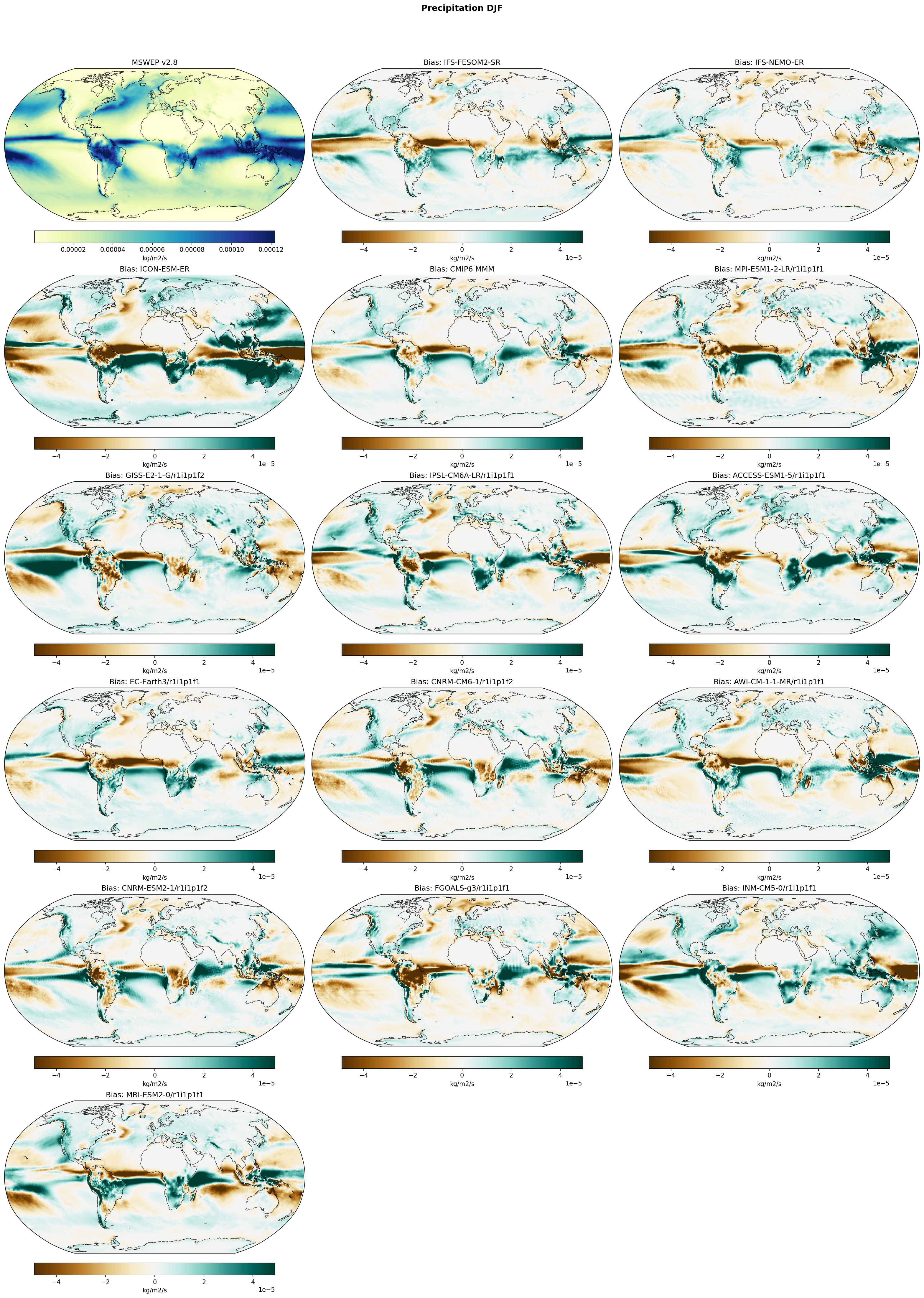
Precipitation DJF Bias
| Variables | pr |
|---|---|
| Models | IFS-FESOM2-SR, IFS-NEMO-ER, ICON-ESM-ER, CMIP6 MMM, MPI-ESM1-2-LR/r1i1p1f1, GISS-E2-1-G/r1i1p1f2, IPSL-CM6A-LR/r1i1p1f1, ACCESS-ESM1-5/r1i1p1f1, EC-Earth3/r1i1p1f1, CNRM-CM6-1/r1i1p1f2, AWI-CM-1-1-MR/r1i1p1f1, CNRM-ESM2-1/r1i1p1f2, FGOALS-g3/r1i1p1f1, INM-CM5-0/r1i1p1f1, MRI-ESM2-0/r1i1p1f1 |
| Reference Dataset | MSWEP |
| Units | kg/m2/s |
| Period | 1980–2014 |
| CMIP6 MMM | Global Mean Bias: 0.00 · Rmse: None |
Summary high
This figure illustrates the precipitation biases in Dec-Jan-Feb (DJF) for high-resolution EERIE simulations (IFS-FESOM2-SR, IFS-NEMO-ER, ICON-ESM-ER) and a suite of CMIP6 models relative to MSWEP v2.8 observations. The analysis reveals persistent systematic biases across generations and resolutions, most notably severe drying over the Amazon and characteristic double-ITCZ patterns in the Pacific.
Key Findings
- A severe dry bias over the Amazon basin is ubiquitous, appearing in both the high-resolution EERIE models (IFS and ICON) and the majority of CMIP6 models, with magnitudes exceeding -4e-5 kg/m²/s (~3.5 mm/day).
- IFS-based models (IFS-FESOM2-SR, IFS-NEMO-ER, EC-Earth3) exhibit a distinct dipole in the tropical Pacific: a dry bias along the equator and a wet bias in the southern tropics (SPCZ region), indicative of a double-ITCZ or southward-shifted ITCZ bias.
- ICON-ESM-ER diverges from the IFS models in the Maritime Continent and Indian Ocean, showing a widespread wet bias, whereas IFS models show a dry bias over the Maritime Continent.
- Extratropical storm tracks (North Atlantic and North Pacific) generally exhibit wet biases across most models, particularly in ICON-ESM-ER and GISS-E2-1-G.
Spatial Patterns
The dominant spatial features are the 'double ITCZ' signature in the Pacific (wet southern band, dry equatorial band), the strong continental dry bias over South America (Amazon), and a dipole in the Indian Ocean (wet western/dry eastern) seen in IFS and CMIP6 MMM. ICON-ESM-ER shows a broader wet bias extending across the tropical Pacific and Maritime Continent. Biases in the high-resolution models reach magnitudes comparable to the mean climatology in some regions.
Model Agreement
There is strong inter-model agreement on the dry bias over South America and the existence of Pacific ITCZ biases. The two IFS-based EERIE models are nearly identical, confirming that atmospheric physics (IFS) rather than ocean coupling (FESOM2 vs NEMO) dominates precipitation errors. ICON-ESM-ER disagrees with IFS in the Maritime Continent and shows stronger wet biases in mid-latitudes, indicating sensitivity to the atmospheric component (ICON vs IFS).
Physical Interpretation
The pervasive Amazon dry bias points to systematic deficiencies in deep convection parameterizations or land-surface coupling (evapotranspiration feedbacks) common to many global models. The Pacific bias patterns (dry equator, wet off-equator) are classic symptoms of the 'double ITCZ' problem, often linked to cold tongue biases and errors in the trade wind strength/Walker circulation. The contrast between IFS (dry Maritime Continent) and ICON (wet Maritime Continent) suggests different treatments of convective triggering or moisture convergence in the Indo-Pacific warm pool.
Caveats
- Analysis is restricted to DJF (Austral summer), which is the wet season for the Amazon and Southern Hemisphere tropics; biases here represent large absolute errors in water availability.
- Observational uncertainty in MSWEP over open oceans should be considered, though the model biases are likely large enough to be robust.
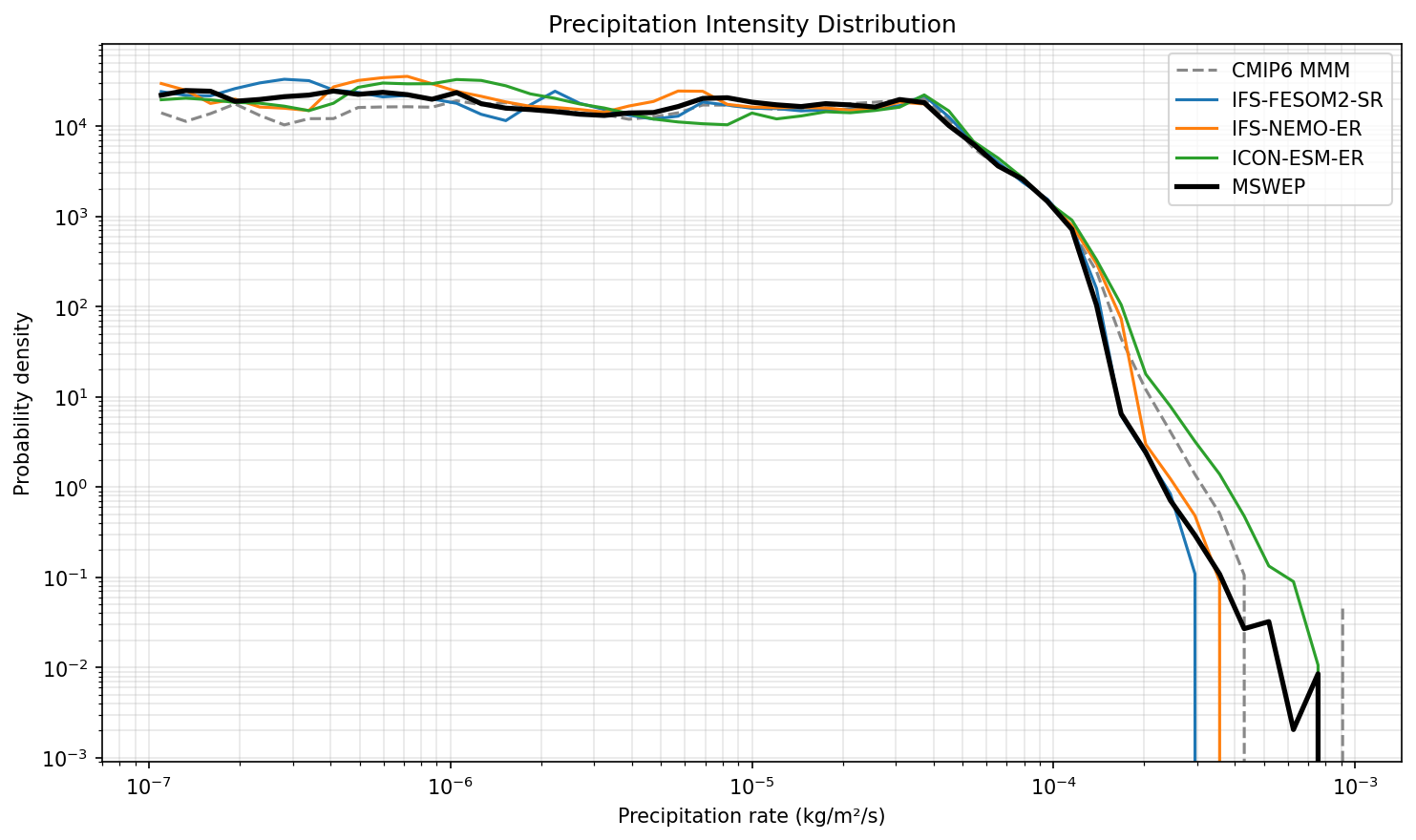
Precipitation Intensity Distribution
| Variables | pr |
|---|---|
| Models | CMIP6 MMM, IFS-FESOM2-SR, IFS-NEMO-ER, ICON-ESM-ER, MSWEP |
| Reference Dataset | MSWEP |
| Units | kg/m2/s |
| Period | 1980–2014 |
Summary high
This figure displays the probability density function (PDF) of precipitation rates (intensity distribution) on a log-log scale, comparing three EERIE simulations and the CMIP6 multi-model mean against MSWEP observations.
Key Findings
- All models and the CMIP6 mean show excellent agreement with MSWEP observations for light to moderate precipitation rates (up to ~4 × 10⁻⁵ kg/m²/s).
- ICON-ESM-ER significantly overestimates the frequency of heavy precipitation events, exhibiting a 'heavy tail' bias where rates >10⁻⁴ kg/m²/s occur much more frequently than in observations.
- A clear resolution effect is visible within the IFS models: the higher-resolution IFS-NEMO-ER captures more extreme precipitation intensities than the lower-resolution IFS-FESOM2-SR, which underestimates the tail.
- IFS-FESOM2-SR drops off the earliest, underestimating the frequency of intense precipitation compared to both MSWEP and the other models.
Spatial Patterns
While this is a global distribution, the regimes correspond to physical phenomena: the broad flat region (< 10⁻⁵ kg/m²/s) corresponds to widespread light rain/drizzle, while the tail (> 10⁻⁴ kg/m²/s) represents intense convective precipitation (ITCZ, storm tracks). The divergence is confined almost entirely to the convective tail.
Model Agreement
Agreement is high for the bulk of the distribution (light/moderate rain). Divergence is significant in the extremes: ICON-ESM-ER > CMIP6 MMM > IFS-NEMO-ER > MSWEP > IFS-FESOM2-SR in terms of tail heaviness at the very extreme end (around 2-3 × 10⁻⁴ kg/m²/s), though ICON is the distinct high outlier.
Physical Interpretation
The 'heavy tail' in ICON-ESM-ER suggests overly vigorous deep convection or insufficient grid-scale mixing of moisture, a common issue when pushing resolution without retuning convective parameterizations. The difference between IFS-NEMO-ER and IFS-FESOM2-SR illustrates the impact of atmospheric resolution: the 'ER' (Eddy-Rich, high-res) configuration resolves smaller, more intense features than the 'SR' (Standard Resolution) configuration, which averages them out. The general agreement in light rain suggests the models do not suffer from the 'too much drizzle' bias often seen in older generations.
Caveats
- Comparison of grid-cell PDFs depends heavily on the native grid resolution; coarser grids naturally smooth out extremes.
- MSWEP observations themselves have uncertainties in estimating extreme precipitation rates, particularly over oceans.
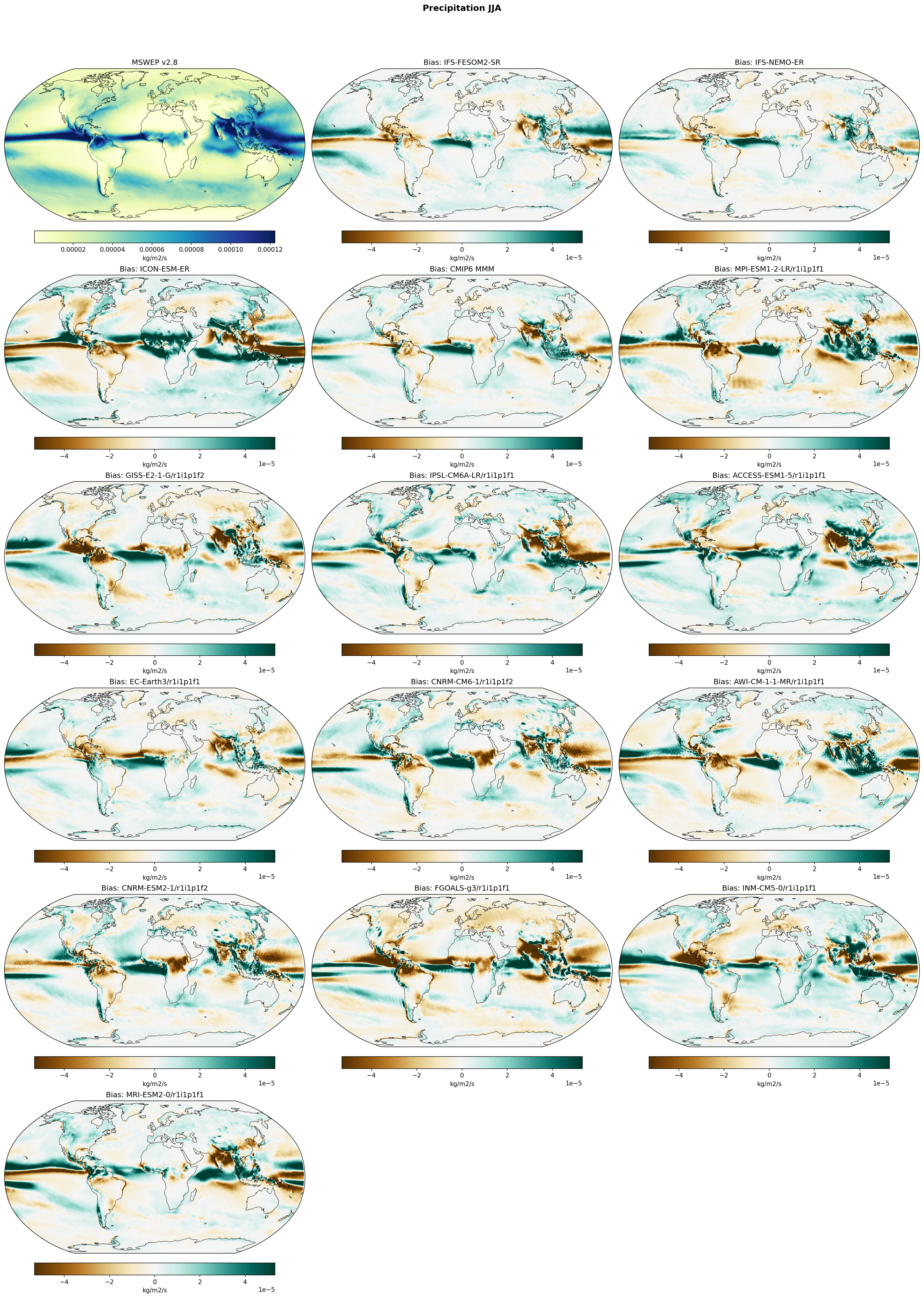
Precipitation JJA Bias
| Variables | pr |
|---|---|
| Models | IFS-FESOM2-SR, IFS-NEMO-ER, ICON-ESM-ER, CMIP6 MMM, MPI-ESM1-2-LR/r1i1p1f1, GISS-E2-1-G/r1i1p1f2, IPSL-CM6A-LR/r1i1p1f1, ACCESS-ESM1-5/r1i1p1f1, EC-Earth3/r1i1p1f1, CNRM-CM6-1/r1i1p1f2, AWI-CM-1-1-MR/r1i1p1f1, CNRM-ESM2-1/r1i1p1f2, FGOALS-g3/r1i1p1f1, INM-CM5-0/r1i1p1f1, MRI-ESM2-0/r1i1p1f1 |
| Reference Dataset | MSWEP |
| Units | kg/m2/s |
| Period | 1980–2014 |
| CMIP6 MMM | Global Mean Bias: 0.00 · Rmse: None |
Summary high
This figure evaluates JJA precipitation biases in high-resolution EERIE simulations (IFS-FESOM2-SR, IFS-NEMO-ER, ICON-ESM-ER) and a range of CMIP6 models against MSWEP v2.8 observations. The analysis highlights systematic biases in the Intertropical Convergence Zone (ITCZ), Indian Summer Monsoon, and tropical landmasses that persist despite increased model resolution.
Key Findings
- Most models, including the high-resolution EERIE runs, exhibit a 'Double ITCZ' bias in the Pacific, characterized by a spurious band of excessive precipitation (wet bias) south of the equator (0-10°S) and often an overly intense northern ITCZ.
- A systematic 'dry land / wet ocean' dipole affects the Indian Summer Monsoon across models; precipitation is overestimated over the Arabian Sea and Indian Ocean but significantly underestimated over the Indian subcontinent and parts of Southeast Asia.
- The IFS-based models (IFS-FESOM2-SR, IFS-NEMO-ER, EC-Earth3) consistently show a pronounced dry bias over the Amazon basin and Central America.
- ICON-ESM-ER displays particularly strong wet biases over the tropical Indian and Pacific Oceans compared to the IFS variants.
Spatial Patterns
The bias maps reveal distinct zonal banding in the tropics. In the Pacific, models generally show a wet bias band in the southern tropics (double ITCZ signature) and a dry bias along the equator (cold tongue region). Over South America, a dry bias is prevalent in the north/central Amazon. In the Indian sector, the monsoon rainfall is displaced southward over the ocean, leaving the continental landmasses drier than observed (brown biases over India/Himalayas).
Model Agreement
There is high structural agreement between IFS-FESOM2-SR and IFS-NEMO-ER, indicating that the choice of ocean model (unstructured vs. structured grid) has minimal impact on the atmospheric precipitation bias patterns. Furthermore, the high-resolution EERIE models share broad bias characteristics with standard-resolution CMIP6 models (e.g., EC-Earth3 resembles the IFS runs; MPI-ESM resembles ICON dynamics), suggesting these errors are driven by physics parameterizations rather than resolution.
Physical Interpretation
The persistence of the Double ITCZ and displaced monsoon rainfall suggests fundamental issues in coupled interactions and convective parameterizations. The 'wet ocean/dry land' monsoon bias implies models trigger convection prematurely over the warm ocean moisture sources, failing to transport sufficient moisture onto the continental landmasses. The dry Amazon bias in IFS models likely relates to errors in surface coupling or evapotranspiration feedbacks typical of that model family.
Caveats
- Biases are shown in kg/m²/s; typical values of ±4e-5 correspond to roughly ±3.5 mm/day, which is a substantial fraction of the climatological mean in these regions.
- Comparison with MSWEP is robust, but observational uncertainty can be higher in data-sparse regions like the Southern Ocean or central Amazon.
Precipitation Seasonal Cycle
| Variables | pr |
|---|---|
| Models | IFS-FESOM2-SR, IFS-NEMO-ER, ICON-ESM-ER, MPI-ESM1-2-LR, GISS-E2-1-G, IPSL-CM6A-LR, ACCESS-ESM1-5, EC-Earth3, CNRM-CM6-1, AWI-CM-1-1-MR, CNRM-ESM2-1, FGOALS-g3, INM-CM5-0, MRI-ESM2-0 |
| Reference Dataset | MSWEP |
| Units | kg/m2/s |
| Period | 1980–2014 |
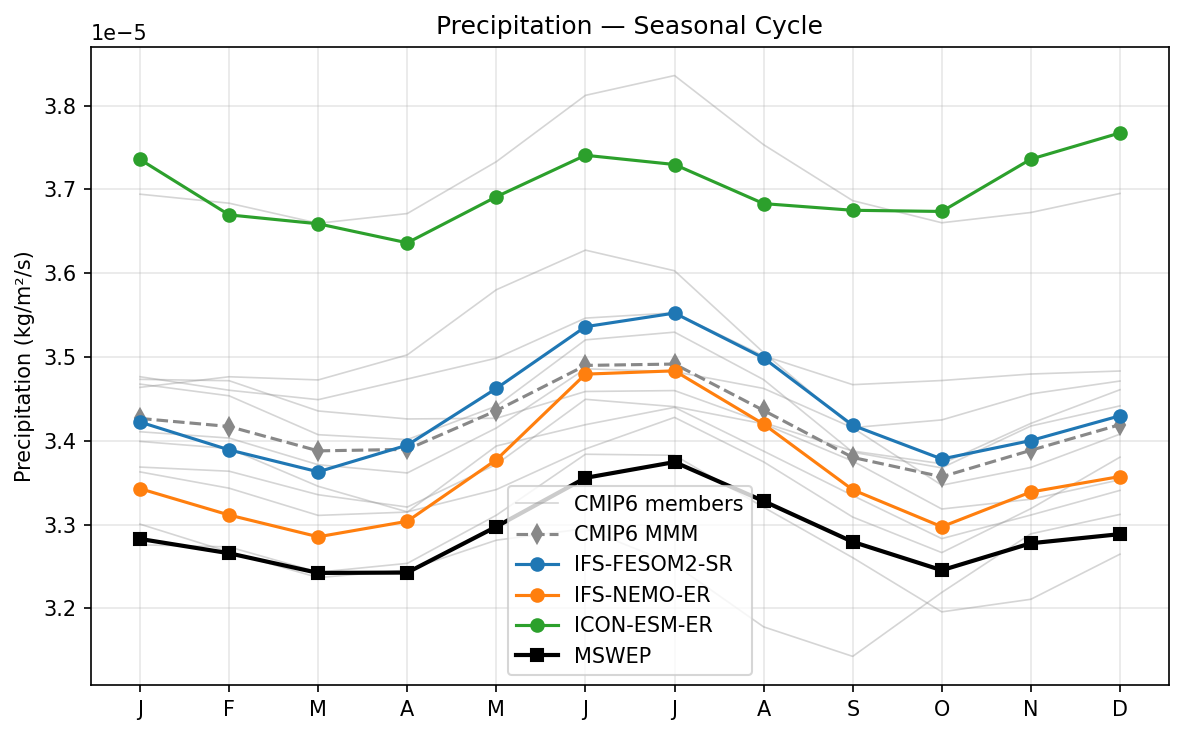
Summary high
The figure illustrates the seasonal cycle of global mean precipitation, comparing three high-resolution EERIE models and the CMIP6 ensemble against MSWEP observations.
Key Findings
- All models exhibit a systematic positive (wet) bias in global mean precipitation relative to MSWEP observations throughout the year.
- ICON-ESM-ER shows the largest positive bias (~10-15% higher than observations) and a distorted seasonal cycle with excessively high precipitation in boreal winter (DJF).
- IFS-NEMO-ER performs best among the displayed models, tracking the observational magnitude closest (particularly in boreal spring) and outperforming the CMIP6 multi-model mean.
- The seasonal phase (peak in July/August) is generally well-captured by the IFS-based models and CMIP6 MMM, reflecting the dominance of Northern Hemisphere land monsoons on the global average.
Spatial Patterns
The global seasonal cycle is characterized by a peak in boreal summer (July/August) and a minimum in boreal spring (March/April). MSWEP shows a range of approximately 3.25e-5 to 3.38e-5 kg/m²/s. The models reproduce the summer peak driven by the migration of the ITCZ and monsoon systems, but generally overestimate the amplitude.
Model Agreement
There is a notable spread between the models. IFS-NEMO-ER and IFS-FESOM2-SR share the same atmospheric component but differ in ocean coupling; IFS-NEMO-ER is consistently drier (closer to obs) than IFS-FESOM2-SR. ICON-ESM-ER is a distinct outlier with much higher precipitation rates. Most CMIP6 members also lie above the observational line, confirming a community-wide tendency towards wet biases.
Physical Interpretation
The pervasive wet bias is a common feature in global climate models, often attributed to excessive convective precipitation ('drizzle problem') and issues in the evaporation-precipitation budget. The difference between IFS-NEMO and IFS-FESOM suggests that SST biases or air-sea coupling differences significantly modulate the global hydrological cycle intensity. The July peak reflects the larger land mass in the Northern Hemisphere supporting stronger monsoonal convection compared to the Southern Hemisphere summer.
Caveats
- Observational uncertainty in global mean precipitation is non-negligible, although MSWEP is a high-quality merged product.
- Global means mask regional compensating errors (e.g., Double ITCZ biases).
Precipitation Global Mean Time Series
| Variables | pr |
|---|---|
| Models | IFS-FESOM2-SR, IFS-NEMO-ER, ICON-ESM-ER, MPI-ESM1-2-LR, GISS-E2-1-G, IPSL-CM6A-LR, ACCESS-ESM1-5, EC-Earth3, CNRM-CM6-1, AWI-CM-1-1-MR, CNRM-ESM2-1, FGOALS-g3, INM-CM5-0, MRI-ESM2-0 |
| Reference Dataset | MSWEP |
| Units | kg/m2/s |
| Period | 1980–2014 |
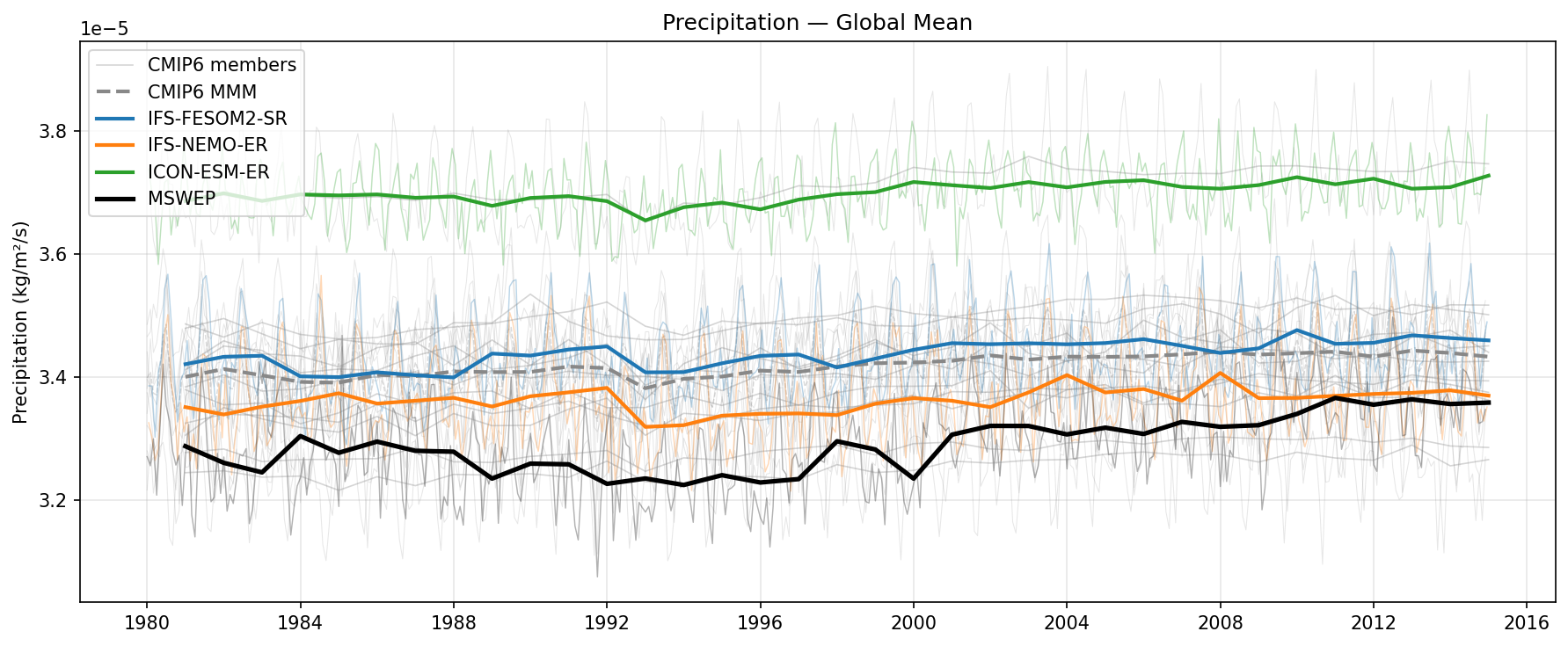
Summary high
This time series compares global mean precipitation (1980–2014) from three high-resolution models (IFS-FESOM2-SR, IFS-NEMO-ER, ICON-ESM-ER) and the CMIP6 ensemble against MSWEP observations. All models exhibit a wet bias relative to MSWEP, with ICON-ESM-ER showing the largest overestimate and IFS-NEMO-ER tracking closest to observations.
Key Findings
- ICON-ESM-ER exhibits a substantial wet bias, averaging ~3.7e-5 kg/m²/s compared to the observational mean of ~3.3e-5 kg/m²/s (an overestimation of approx. 12%).
- IFS-NEMO-ER shows the best agreement with observations among the highlighted models, lying just above the MSWEP line (~3.35-3.4e-5 kg/m²/s) and performing better than the CMIP6 Multi-Model Mean.
- IFS-FESOM2-SR lies between the other two, closely following the CMIP6 Multi-Model Mean trajectory.
- A distinct drop in global precipitation is visible around 1991-1992 in the IFS models and MSWEP, likely the hydrological response to the Mt. Pinatubo eruption.
- MSWEP shows a marked upward trend in global precipitation from roughly 2000 onwards which is not fully captured in magnitude by the models.
Spatial Patterns
While this is a global mean time series, temporal patterns reveal a hydrological sensitivity to volcanic forcing (1991 Pinatubo dip) and a multi-decadal increase in the observational record that exceeds the linear trends seen in most models.
Model Agreement
There is a systematic wet bias across the model ensemble (CMIP6 and EERIE models) relative to MSWEP. IFS-NEMO-ER is the best-performing outlier on the lower (drier) side, while ICON-ESM-ER is an outlier on the higher (wetter) side, sitting at the upper bound of the CMIP6 ensemble spread.
Physical Interpretation
Global mean precipitation is energetically constrained by the radiative cooling of the atmosphere (balancing latent heat release). The excess precipitation in ICON-ESM-ER suggests a too-vigorous hydrological cycle, possibly linked to excessive surface evaporation or radiative cooling biases. The 1991 dip demonstrates the fast hydrological response to solar dimming from volcanic aerosols (reduced surface energy availability). The lower bias in IFS-NEMO-ER compared to IFS-FESOM2-SR may result from cooler SSTs in the eddy-rich configuration or differences in atmospheric tuning.
Caveats
- Global mean precipitation observations are subject to considerable uncertainty; MSWEP blends gauge, satellite, and reanalysis data, but other datasets (e.g., GPCP) might show different absolute means.
- The apparent trend in MSWEP post-2000 could partially result from inhomogeneities in the observing system (e.g., changing satellite constellations).
Precipitation Zonal Mean Profile
| Variables | pr |
|---|---|
| Models | CMIP6 MMM, IFS-FESOM2-SR, IFS-NEMO-ER, ICON-ESM-ER, MSWEP |
| Reference Dataset | MSWEP |
| Units | kg/m2/s |
| Period | 1980–2014 |
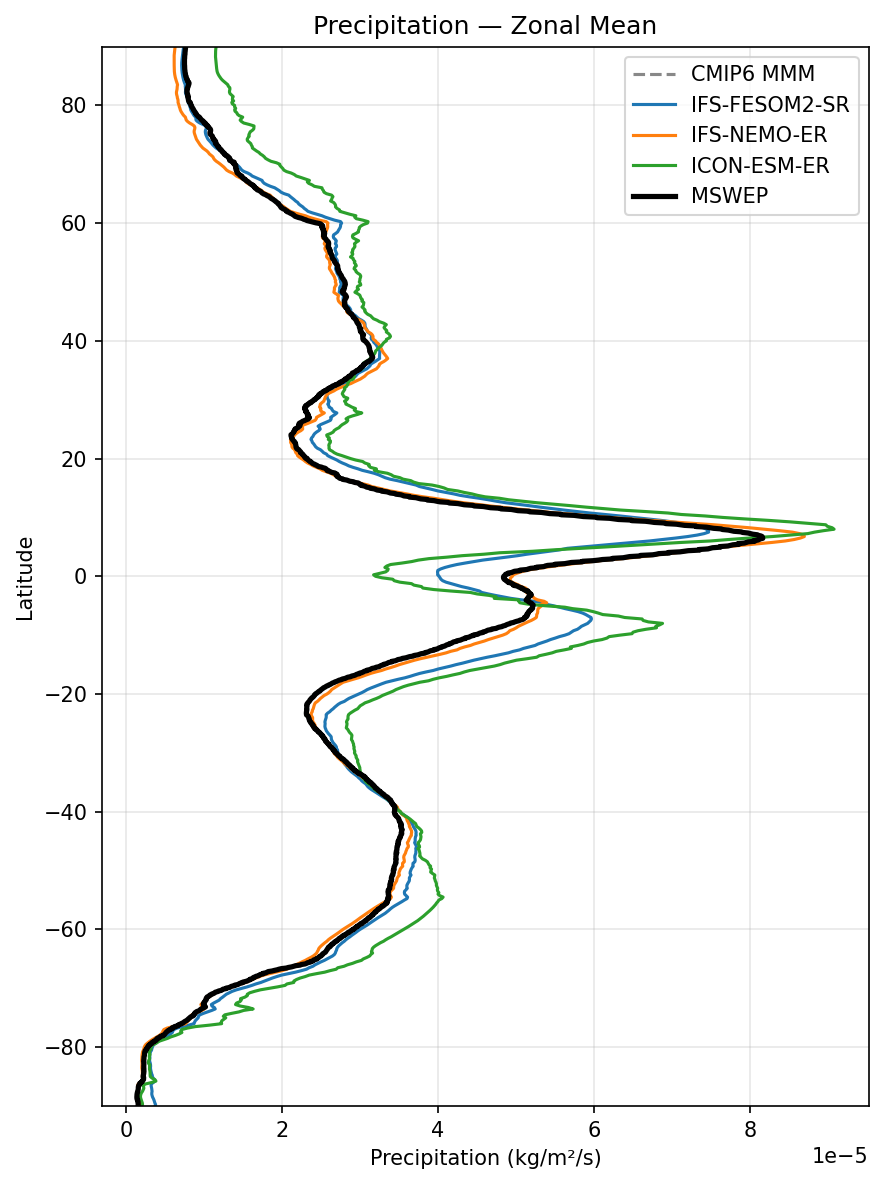
Summary high
The figure presents zonal mean precipitation profiles, comparing three high-resolution coupled models against MSWEP observations. While the IFS-based models demonstrate high skill in reproducing the observed latitudinal structure, ICON-ESM-ER exhibits a systematic wet bias across the tropics and mid-latitudes, obscuring the definition of subtropical dry zones.
Key Findings
- IFS-FESOM2-SR (blue) and IFS-NEMO-ER (orange) show excellent agreement with observations, accurately capturing the ITCZ peak intensity (~8.5e-5 kg/m²/s) and the depth of the subtropical dry zones.
- ICON-ESM-ER (green) is a significant outlier with a global positive precipitation bias; it overestimates the ITCZ peak and fails to reproduce the low precipitation rates in the subtropical subsidence regions (approx. 15-30° N/S).
- ICON-ESM-ER displays a 'double ITCZ' tendency, evidenced by a broad tropical peak and excessive precipitation in the Southern Hemisphere tropics (0-10°S) compared to the sharp, northern-hemisphere-dominated peak in MSWEP and IFS models.
Spatial Patterns
The profile clearly delineates the major limbs of the global circulation: the equatorial ITCZ rainfall maximum (peaking ~6-8°N), the subtropical dry zones (Hadley cell subsidence regions around 20-30° latitude), and the secondary maxima in the mid-latitude storm tracks (40-50° latitude). The observational asymmetry (wetter NH ITCZ) is well captured by IFS, while ICON produces a more symmetric, broader tropical wet zone.
Model Agreement
There is strong agreement between the two IFS variants (FESOM2 and NEMO), suggesting that the choice of ocean model grid (unstructured vs. structured) has minimal impact on the zonal mean atmospheric precipitation state compared to the atmospheric physics package. In contrast, the inter-model spread is large due to ICON-ESM-ER's pervasive wet bias, which diverges significantly from both IFS models and observations.
Physical Interpretation
The systematic wet bias in ICON-ESM-ER, particularly in the subtropical dry zones, suggests issues with convective parameterization (triggering too frequently or insufficient entrainment/drying) or weak large-scale subsidence in the Hadley circulation. The excessive precipitation in the mid-latitudes for ICON indicates potentially overactive storm tracks or excessive poleward moisture transport. The IFS atmospheric component appears better tuned, balancing radiative cooling and latent heating to match observed precipitation rates closely.
Caveats
- The CMIP6 MMM line, while listed in the legend, is not clearly visible in the plot, preventing a direct comparison with standard-resolution models.
- Zonal averaging masks potential regional biases (e.g., specific monsoon failures or dry biases over land vs. ocean) that might cancel out in the mean.